
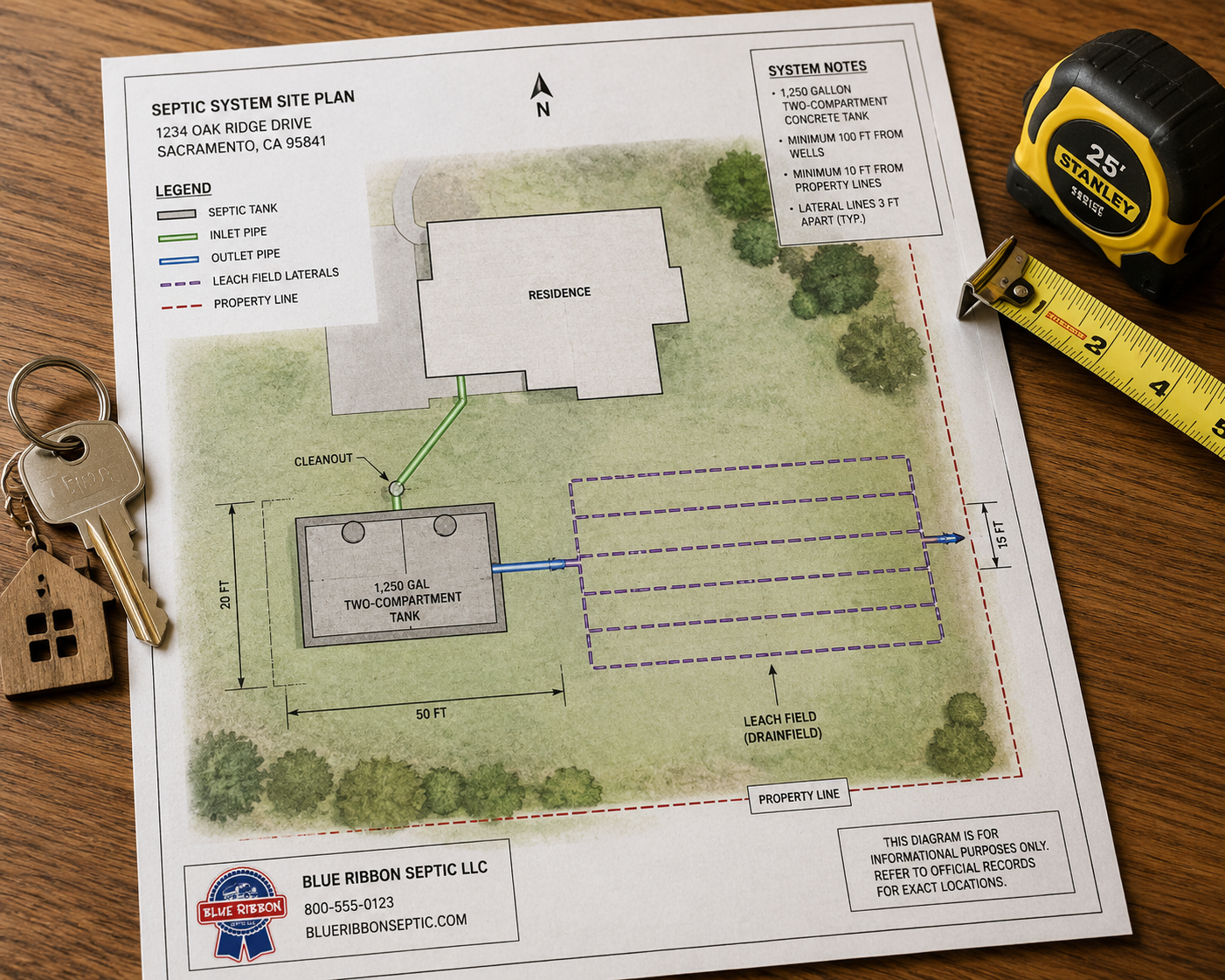
A septic tank diagram is a visual map of your home’s underground wastewater system, showing exactly where your tank, pipes, and soil treatment area are located. Understanding this diagram of septic system components is the first step in preventing "invisible" problems from turning into a backyard emergency. For many homeowners in the Sacramento area, the first time they think about their system’s layout is during a backup, but knowing your septic tank diagram beforehand allows you to protect your property from heavy vehicles, deep-rooted landscaping, and costly structural damage.
In this guide, you will learn how to identify the critical parts of septic tank systems and interpret a typical septic system layout like a pro. By the end, you’ll be able to make informed decisions about maintenance and communicate more effectively with service technicians.
Let’s start by breaking down the specific components you'll see on a standard schematic.
Understanding Your Septic Tank Diagram and Why It Matters
A septic tank diagram is a technical drawing or schematic that illustrates the positioning and connection of your home’s onsite wastewater treatment system. It serves as a master blueprint, detailing the anatomy of a septic system from the point where the main sewer line leaves your house to the final distribution in the soil. At its core, this septic tank schematic identifies the location of the holding tank, the baffles that manage flow, and the network of pipes leading to the absorption area.
For homeowners in communities like Loomis or Granite Bay, having this document on hand is essential for protecting your property investment. Without a clear septic tank diagram, you are essentially flying blind; you might accidentally park a vehicle over a sensitive pipe or plant a tree whose roots will eventually crush your tank. Understanding your typical septic system layout allows you to perform visual checks and ensures that when you schedule septic tank cleaning and pumping, our technicians can locate your system immediately, saving you time and avoiding unnecessary digging in your yard.
Maintaining an accurate record of your system provides several practical advantages:
- Faster Troubleshooting: If you notice soggy patches in the yard, the diagram helps pinpoint if the issue is a tank leak or a distribution line problem.
- Regulatory Compliance: Having a clear real estate septic system inspection and diagram is often a requirement for selling your home.
- Cost Prevention: Knowing the location of your components prevents accidental damage during landscaping or home additions.
Many people assume their system is just a single "box" in the ground, but the reality is a multi-stage process. Misidentifying where the tank ends and the filtration begins is a common mistake that can lead to improper maintenance.
Breaking Down the Blueprint: How to Read Your Septic Tank Diagram
Correctly interpreting a septic tank diagram is about more than just identifying boxes and lines; it is about understanding the flow of wastewater and the health of your property. When you look at your schematic, you are viewing a top-down map of how your home handles waste. Whether you are preparing for tank locating and outlet baffle replacement or simply trying to understand your yard’s layout, these diagrams provide the essential roadmap.
1. The Main Sewer Line and Tank Entry
The first line you will typically see on a septic system plumbing diagram is the one leading from the house to the tank. This is the main drainage pipe. On a schematic, it is usually represented by a solid line.
- What to look for: Note the distance from the house foundation to the tank. This helps you avoid digging in the wrong spot or accidentally placing heavy structures over the main line.
- Pro Tip: If the line has sharp turns, the diagram may show a "cleanout" access point. Knowing where this is can save hours of troubleshooting if you experience a clog between the house and the tank.
2. Identifying the Parts of a Septic Tank
The tank itself is usually drawn as a large rectangle or oval. A detailed septic tank schematic will show the internal "baffles", the T-shaped pipes at the inlet and outlet.
- Inlet Baffle: Directs incoming waste downward into the tank to prevent splashing and keep the "scum layer" (floating grease and oils) from clogging the entry pipe.
- Outlet Baffle: This is perhaps the most critical component. It ensures that only liquid, not solids, exits the tank toward your drain field.
- Access Manholes: These are indicated by small circles on top of the tank. If your diagram shows these are buried deep, you might consider septic risers and lid installation to bring access to the surface, making future maintenance much easier.
3. Understanding the Septic Leach Field Diagram
Once the liquid (effluent) leaves the tank, it moves into the absorption area. On a septic leach field diagram, this looks like a series of parallel lines or a "fork" shape extending away from the tank.
- The Distribution Box (D-Box): Often shown as a small square between the tank and the field, the D-Box evenly distributes effluent to the various lateral lines of the leach field.
- Lateral Lines: These are the perforated pipes that allow liquid to soak into the soil. It is vital to know exactly where these are so you never drive over them, as the weight of a vehicle can crush these pipes and lead to total system failure.
4. Special Features: Lift Stations and Pumps
In many parts of Northern California, such as Foresthill or Grass Valley, the natural terrain is hilly. If your drain field is located at a higher elevation than your house, your septic tank diagram will include a second tank or a compartment known as a pump chamber or lift station.
- The Pump: This pushes the effluent uphill to the leach field. If your diagram shows a pump, it means your system has electrical components and alarms that require specialized monitoring to ensure they don't burn out or overflow.
Putting the Information to Use
By cross-referencing your septic tank diagram with your actual yard, you can create a "protection zone." Use the measurements on the schematic to find the corners of your leach field and the lids of your tank. Understanding this anatomy of a septic system empowers you as a homeowner. You’ll know exactly where to look for signs of trouble, like lush green grass over a specific lateral line, and you’ll be able to provide clear instructions to service providers, ensuring your system gets the honest, expert care it deserves.
Applying Your Septic Tank Diagram to Real-World Scenarios
Now that you can identify the symbols on your septic tank diagram, it is time to see how this knowledge prevents property damage and saves you money. Moving from a technical drawing to a physical plan ensures your home’s infrastructure remains protected during everyday life.
Practical Use Cases
- Landscaping and Backyard Projects: A homeowner in Lincoln wanted to install a new fence and used their septic system diagram to verify the exact path of the main sewer line. By identifying the line’s location on the schematic before digging post holes, they avoided a punctured pipe that would have cost thousands in emergency repairs. This proactive check ensured the project moved forward without compromising the septic leach field diagram boundaries.
- Preparing for Real Estate Transactions: During a home sale in Granite Bay, the seller provided a clear septic tank diagram to the buyer’s agent. This transparency allowed for a smooth real estate septic system inspection, as the inspector could immediately locate the tank lids and distribution box. The deal closed on time because there were no "mystery" components or hidden system failures to investigate.
- Emergency Troubleshooting: When a family noticed slow drains, they checked their septic tank schematic and realized the area over their outlet baffle was unusually soggy. They called for a professional evaluation, and because they could point the technician directly to the baffle location, the repair was completed in half the time.
Whether you are planning a renovation or simply maintaining your yard, these real-world applications prove that a little technical knowledge goes a long way. Understanding your layout keeps your system out of sight and out of mind, just as it should be.
Pro Tips for Managing Your Septic Tank Diagram and System Health
Having a septic tank diagram is a great start, but using it effectively requires a few professional insights. Moving from a basic understanding to expert-level care ensures your septic system plumbing diagram remains a functional tool rather than just a dusty piece of paper.
- Physically Map the Components in Your Yard Once you have your septic tank diagram, use a measuring tape to locate the tank and leach field corners. Place a small, discreet marker or decorative stone over the tank lids. This prevents guesswork when you need tank locating or baffle replacement and ensures you never accidentally plant deep-rooted shrubs too close to the sensitive parts of septic tank systems.
- Keep a Digital and Physical Backup Paper records can be lost or damaged by water. Scan your septic tank schematic and save it to a cloud drive. Having a digital copy on your phone allows you to show it to a technician instantly, even if you are away from home when a problem arises.
- Update the Diagram After Any Repair If you install a new lift station or add risers, mark these changes on your layout. An outdated typical septic system layout can lead to confusion during future inspections. Accurate records are the backbone of a stress-free maintenance schedule.
By following these practical steps, you transform a simple drawing into a comprehensive protection plan for your property’s most vital infrastructure.
Next Steps: Putting Your Septic Tank Diagram to Work
Your septic tank diagram is more than just a technical drawing; it is the key to maintaining a healthy, long-lasting waste management system. You now understand how to identify the critical parts of septic tank infrastructure and how a typical septic system layout dictates where you can safely build or plant on your property. Armed with this knowledge, you can move from reactive repairs to proactive care, ensuring your system operates efficiently for decades.
Taking the time to locate your tank and understand your septic tank diagram now will save you from the stress and expense of an emergency backup later. Whether you are a new homeowner in Rocklin or have lived on your property in Loomis for years, being an informed owner is the best way to protect your home’s value and your family's comfort.
If you are struggling to locate your tank or need an expert to verify your system's condition, we are here to provide honest, no-pressure assistance. Contact us today for professional septic tank cleaning and pumping to keep your system running exactly as it should.
Common Questions About Your Septic Tank Diagram
Where can I find a copy of my septic system diagram?
Most homeowners can find their septic system diagram through their local county health department or building permit office. In areas like Placer or Sacramento County, these records are often kept on file from when the system was originally installed or last modified. If no public record exists, a professional can perform tank locating and mapping to create a fresh septic tank schematic for your property.
How do I read the symbols on a septic tank and drain field diagram?
On a typical septic tank and drain field diagram, solid lines usually represent the main plumbing pipes, while a large rectangle indicates the tank itself. The leach field is often shown as a series of dashed or parallel lines spreading out from a central distribution box. Circles typically denote access manholes or risers. Understanding these symbols helps you identify the anatomy of a septic system and prevents you from accidentally landscaping over critical components.
Does every septic tank diagram show a pump or lift station?
No, not every septic tank diagram includes a pump. Most standard systems rely on gravity to move effluent from the tank to the leach field. However, if your property has hilly terrain, your diagram of septic system components will show a second chamber or "lift station." This is an essential distinction because systems with pumps require more frequent electrical inspections and specialized maintenance to prevent overflow alarms and pump failure.
Why is the septic leach field diagram the most important part?
The septic leach field diagram is vital because it shows the "absorption area," which is the most sensitive part of your yard. Unlike the tank, which is made of heavy concrete or plastic, the leach field consists of perforated pipes buried in gravel and soil. Knowing this layout ensures you never park vehicles, build sheds, or install pools over the area, as soil compaction or pipe damage can lead to a total system collapse.


